LawLynx
In developmentIndependent platform, pre-betaSmall law firms want AI help with research and documents without handing client identities to outside models. LawLynx puts a PII gate in front of every external model, routes each question by complexity, and sends the high-stakes ones to three models at once.

What it does
- 51 specialized AI agents built in Next.js and TypeScript on Supabase and PostgreSQL.
- A PII gate redacts all 18 HIPAA identifiers before content reaches an external model.
- A router scores query complexity to pick the model tier, and high-stakes questions go to a three-model panel (Claude, GPT, Gemini).
From my resume.
Who it is for
Attorneys and staff at small law firms.
The outcome
18 of 18
HIPAA identifiers redacted before any external model sees the text.
How it works
Ask
A lawyer asks a question in the chat workspace.
Redact
The PII gate removes all 18 HIPAA identifiers.
Route
A router scores the question's complexity and picks the model tier.
Panel
High-stakes questions go to a three-model panel: Claude, GPT, and Gemini.
Answer
One of 51 specialized agents answers in the workspace.
The real screens
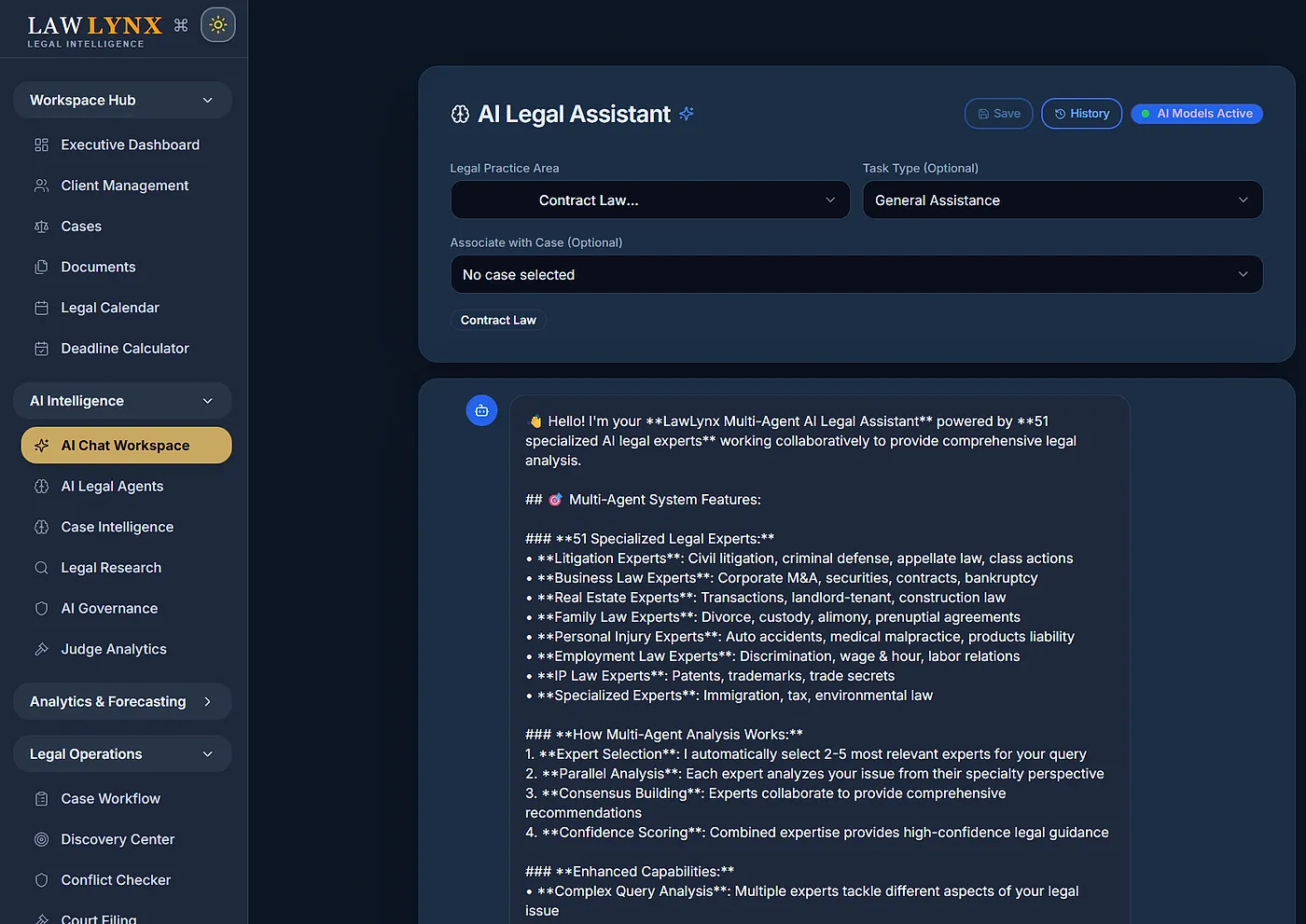
Practice area and task. The lawyer frames the question before any agent sees it.
51 specialists. The assistant draws on 51 specialized legal agents.

The decision that matters
Fail closed
If the PII gate cannot run in production, the request stops. The regex fallback exists only in development, so an outage never quietly sends client text out unredacted.
Built with
- Next.js
- TypeScript
- Supabase
- PostgreSQL
- Claude, GPT, and Gemini
Checked evidence
- Verified In production, a missing token is a hard error. The regex fallback runs only in development.